Tutorial: Comparing lexical variation between two novels
This tutorial uses the lexical semantic pipeline in the LanguageChange library to compare Pride and Prejudice (1813) and Little Women (1868) to study how the adjective agreeable is used across the two novels. It goes from loading the corpora, to searching for the target word, to running the pipeline, and finally to visualizing the results.
To reproduce the tutorial, run the notebook available in the notebooks directory of the repository. The data used in this tutorial can be downloaded from project Gutenberg: Pride and Prejudice and Little Women.
However, feel free to use any other novels or target words of your choice! The tutorial is meant to be a compact workflow for comparing lexical variation between two texts, and can be adapted to other settings as needed.
Load the two novels

Here we load the two novels as separate corpora, and assign them their respective publication years as time information.
from pathlib import Path

from languagechange.corpora import HistoricalCorpus, LinebyLineCorpus
from languagechange.utils import LiteralTime

target = "agreeable"
corpus_dir = Path("corpora")

pp_corpus = LinebyLineCorpus(
   str(corpus_dir / "pp-tokens-lemmas.txt"),
   language="english",
   is_tokenized=True,
   is_lemmatized=True,
   time=LiteralTime("1813"),
)
lw_corpus = LinebyLineCorpus(
   str(corpus_dir / "lw-tokens-lemmas.txt"),
   language="english",
   is_tokenized=True,
   is_lemmatized=True,
   time=LiteralTime("1868"),
)

novels = HistoricalCorpus([pp_corpus, lw_corpus])
Search for the target word

Search by lemma so that all inflectional variants are grouped together:
from languagechange.search import SearchTerm

search_term = SearchTerm(lemma=target)
term = str(search_term)

pp_usages = pp_corpus.search(search_term)
lw_usages = lw_corpus.search(search_term)

print(f"Pride and Prejudice (1813): {len(pp_usages[term])}")
print(f"Little Women (1868): {len(lw_usages[term])}")
On the notebook data this gives:
Pride and Prejudice (1813): 45
Little Women (1868): 22
Next, sample usages and store them in the domain structure expected by the pipeline. Here the two domains are simply the two novels. This step is not necessary for this data, but if you have a lot of usages, it can be useful to sample a subset of them for the pipeline. The sampling function also allows you to sample usages per time period, which can be useful if you have more fine-grained time information.
from languagechange.utils import LiteralTime

novel_comparison_usages = {
   term: {
      "Pride and Prejudice": pp_usages[term].sample_per_time(
         times=[LiteralTime("1813")],
         n_samples=100,
      ),
      "Little Women": lw_usages[term].sample_per_time(
         times=[LiteralTime("1868")],
         n_samples=100,
      ),
   }
}
Run the comparison pipeline
Encode the usages with XL-LEXEME, cluster them, and compare the two novels as separate domains:
import torch
from sklearn.cluster import AgglomerativeClustering

from languagechange.models.change.metrics import JSD
from languagechange.models.representation.contextualized import XL_LEXEME
from languagechange.pipeline import CDPipeline

device = "cuda" if torch.cuda.is_available() else "cpu"

model = XL_LEXEME(device=device)
clustering_algorithm = AgglomerativeClustering(
   n_clusters=None,
   distance_threshold=0.5,
   linkage="complete",
   metric="cosine",
)
metric = JSD()

pipeline = CDPipeline(
   novel_comparison_usages,
   model,
   metric,
   clustering_algorithm,
)

sampled, embeddings, cluster_labels, change_scores = (
   pipeline.run_pipeline()
)
Visualize the two novels

Plot the embeddings for each novel:
from languagechange.visualization import Visualizer

visualizer = Visualizer(
   usages=sampled[term],
   embeddings=embeddings[term],
   cluster_labels=cluster_labels[term],
   target=term,
)

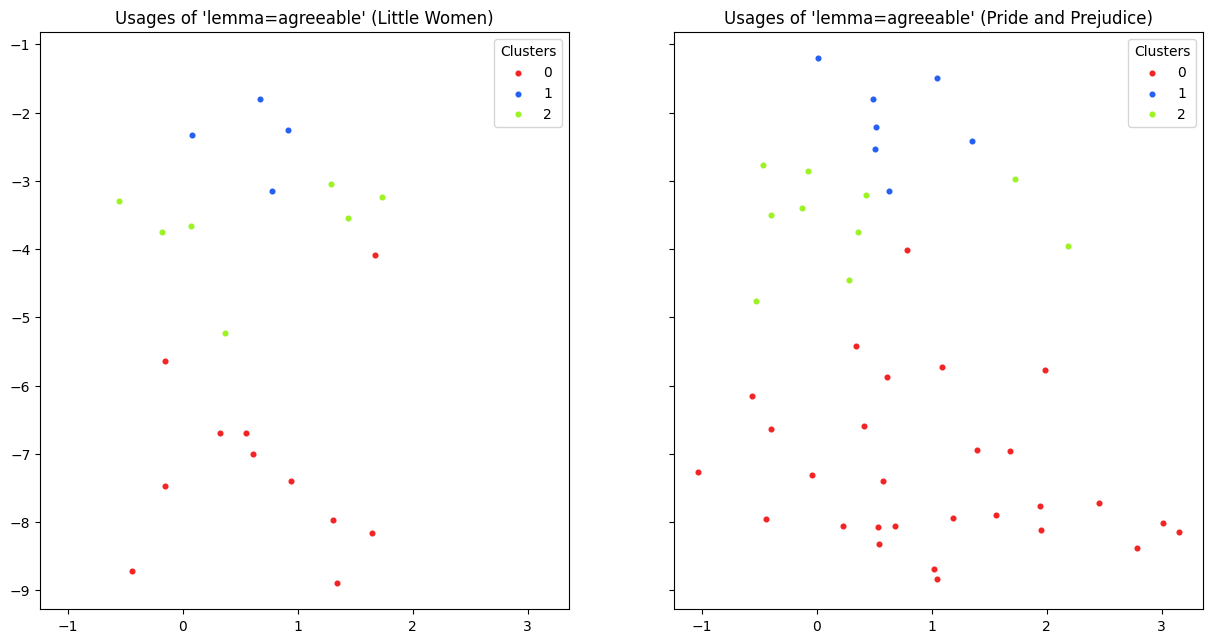
visualizer.plot_usage_embeddings()
The visualization for the two novels looks like this:
Inspect example usages
We can then inspect usages from the clusters:
visualizer.display_usages(max_usages=10, randomize=True)
Looking at example sentences per cluster makes it easier to interpret what kinds of contexts define each group. For example, cluster 0 seems to be more aligned with “agreeable” in the sense of being an accomplished social person, while cluster 1 and 2 are more related to “agreeable” in the sense of something being an acceptable situation.
Cluster 0
1813: Her fellow - travellers the next day , were not of a kind to make her think him less **agreeable** .

1813: " I dare say you will find him very **agreeable** . "

1813: His pride never deserts him ; but with the rich , he is liberal - minded , just , sincere , rational ,
honourable , and perhaps **agreeable** , -- allowing something for fortune and figure . "

1868: " I merely intend to make myself entrancingly **agreeable** to every one I know , and to keep them in your corner as long as possible .

1813: She could not think of Darcy 's leaving Kent , without remembering that his cousin was to go with him ; but Colonel Fitzwilliam had made it clear that he had no intentions at all , and **agreeable** as he was , she did not mean to be unhappy about him .
Cluster 1
1868: The little girls , however , considered it a most **agreeable** and interesting event ...

1813: " It has been a very **agreeable** day , " said Miss Bennet to Elizabeth .

1813: is not this an **agreeable** surprise ? "

1868: ... but the impulse that wrought this **agreeable** change was the result of one of the new impressions ...

1813: It must have been a most **agreeable** surprise to Mr. Bingley ...

1868: ... two **agreeable** things , which made her feel unusually elegant and ladylike .
Cluster 2
1813: His ease and cheerfulness rendered him a most **agreeable** addition to their evening party ...

1813: But there is one of her sisters sitting down just behind you, who is very pretty, and I dare say, very **agreeable**.

1868: ... two **agreeable** things, which made her feel unusually elegant and ladylike.

1868: Fred is very entertaining, and is altogether the most **agreeable** young man I ever knew ...
Having model automatically create these clusters can help us discover patterns of usages that otherwise might not have noticed.